
Whitepaper · Updated May 2026
Nakamoto Capital
Nakamoto Capital or NKTdao is An on-chain venture studio that builds and operates blockchain-native products. Instead of acting as a traditional fund, Nakamoto Capital participates directly in the systems it creates, owning infrastructure, integrating into revenue flows, and aligning incentives through $NKT.
Overview
Nakamoto Capital is an on-chain venture studio focused on building and operating blockchain-native products on Solana.
Rather than functioning as a traditional investment fund, Nakamoto Capital actively participates in the ecosystems it creates integrating products, governance infrastructure, and treasury systems through a unified coordination layer powered by $NKT.
Initial ecosystem development is focused on NFT infrastructure, treasury governance, and community-owned on-chain products. As new products launch and generate revenue, a portion of that value is routed back into the treasury and broader NKT ecosystem through on-chain infrastructure and buyback mechanisms.
Vision
Nakamoto Capital is designed as a community-driven Web3 ecosystem focused on sustainable infrastructure rather than short-term hype cycles.
The project prioritizes empowering builders, developers, designers, and contributors through decentralized governance, treasury participation, and long-term ecosystem development on Solana.
Unlike trend-driven token launches, Nakamoto Capital focuses on creating an adaptable ecosystem where the community helps shape product direction, treasury decisions, and future expansion.
What We Build
Nakamoto Capital focuses on three areas:
- Tokenized Systems Products with built-in economic models and on-chain value flow.
- Automation & AI Infrastructure Systems that reduce manual operations and improve scalability.
- Decentralized Governance Tools Frameworks that allow contributors and holders to participate in decision-making.
Each product is designed to operate independently while contributing economically to the broader ecosystem.
Ecosystem Model
The system is designed to create a consistent feedback loop:
-
1
Products generate revenue across the portfolio.
-
2
A portion of revenue is routed to the treasury.
-
3
The treasury allocates capital, including NKT buybacks.
-
4
Increased demand supports the ecosystem and future growth.
Revenue routing is defined at the product level and enforced either on-chain or through structured agreements.
Role of NKT
NKT is the representation of the entire ecosystem. Every product, every revenue stream, and every contributor benefits from it, and it benefits from all of them in return.
Its main use is governance: holders vote on proposals that shape the direction of the project, from treasury allocation and new product approvals to strategic decisions.
Beyond voting, NKT is the way participants grow with the project. As the ecosystem expands and the products it powers start to generate revenue, that activity routes back into the token and the treasury, so holding NKT is the most direct way to share in the upside of what Nakamoto Capital builds.
NKT Mechanics
NKT includes a base transaction fee of 2.5%, designed to support long-term operations. These parameters may be adjusted through governance if needed.
1.0%
Treasury
Funds development, operations, and reserves.
0.5%
Buyback & Burn
Reduces circulating supply over time.
0.5%
Liquidity
Supports market depth and reduces volatility.
0.5%
Rewards
Funds community airdrops and ongoing reward programs.
Revenue Model
Nakamoto Capital is funded through multiple channels:
- Product Revenue Income generated from ecosystem products.
- Token Activity Transaction fees and market participation.
- NFT Issuance Direct funding used for liquidity and operations.
This diversified structure reduces reliance on any single source of capital and supports more stable growth.
Treasury
The treasury is the core financial layer of the system. It receives funds from:
- Product revenue generated across the portfolio.
- Transaction fees from on-chain NKT activity.
- Strategic activities coordinated by the DAO.
The treasury is used for:
- Funding development across active products.
- Supporting ecosystem growth and new launches.
- Executing buybacks of NKT.
- Maintaining reserves for long-term resilience.
The treasury is currently held in a multi-signature wallet that receives all incoming revenue, with payouts requiring agreement from multiple core team members so no single person can move funds. After launch, the treasury transitions to a DAO wallet controlled by on-chain votes through the governance portal on our website, so allocations, buybacks, and disbursements are executed by the holders rather than the founding team.
All treasury activity is transparent and verifiable on-chain.
Governance
Nakamoto Capital operates as a DAO. Governance is gated by the Who's Satoshi NFT collection: you must own a Who's Satoshi NFT to access the governance space. That's where proposals are posted, debated, and refined before they go to a vote. Without the NFT, you can't see the discussions.
Voting itself happens on our website, in a portal gated by the Who's Satoshi NFT collection, and the weight of each vote is determined by NKT. The rule is simple: 1 NKT = 1 vote on every proposal: treasury allocation, new product approvals, parameter changes, and major strategic decisions. Owning the NFT gets you in the room, and holding NKT determines the weight of your vote.
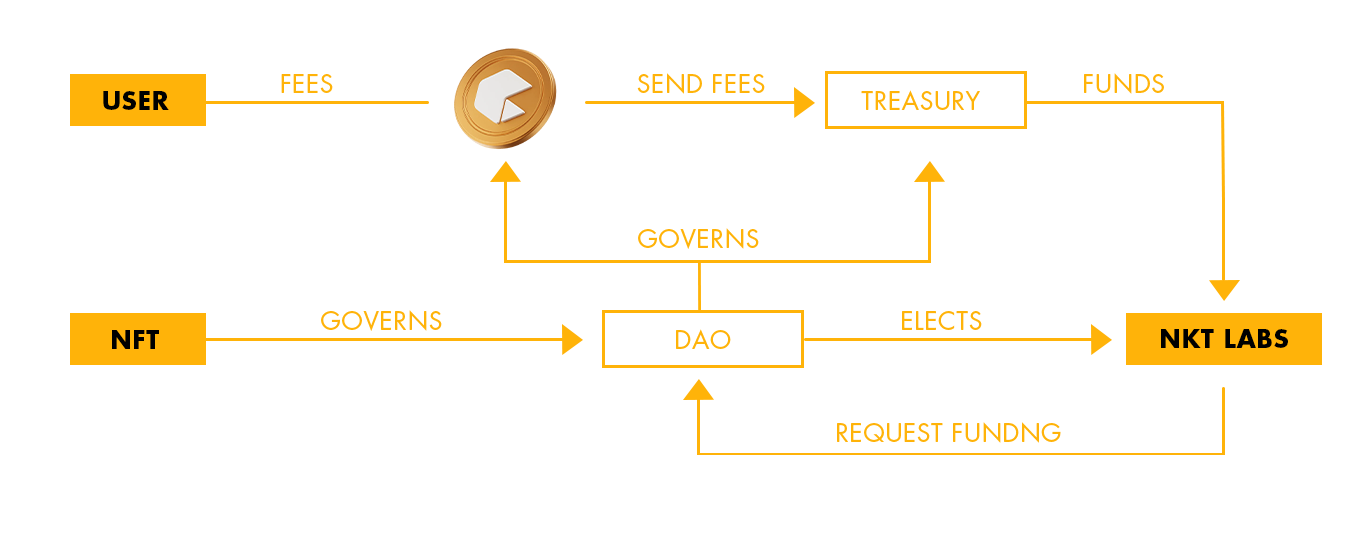
For the full picture of how proposals, votes, the treasury, and revenue interact, see the DAO Fluxogram.
DAO Fluxogram
The Nakamoto Capital ecosystem at a glance. This is how products, the treasury, NKT, and governance connect into a single feedback loop.
NFT Funding Layer
Nakamoto Capital introduces an NFT-based capital layer designed to fund ecosystem growth. Each NFT mint contributes directly to liquidity and operational funding, including:
- Product development and maintenance across the portfolio.
- Design and branding for new launches.
- Infrastructure and hosting for live products.
100% of NFT proceeds are allocated to the Treasury, strengthening Nakamoto Capital and supporting our long-term stability.
Tokenomics
Total supply is fixed at 1,000,000 NKT. Allocations are designed to balance access, liquidity, and long-term alignment.
Open distribution to participants and community.
Pools and market depth across venues.
Long-term alignment with the project's success.
Strategic guidance across the ecosystem.
Strategic reserves for growth and operations.
Security
Security is handled at both the contract and operational level.
- Independent audits Smart contracts will undergo third-party audits.
- Pre-deployment testing Critical systems are tested before going live.
- On-chain transparency Treasury activity is publicly verifiable.
2026 Roadmap
Nakamoto Capital is being developed in progressive phases focused on infrastructure, governance, treasury growth, and decentralized execution.
Each stage unlocks sequentially as ecosystem milestones, treasury stability, and community participation mature.
-
Q2 2026 Foundation Phase · Active
- NKT Token Presale Launch
- Who's Satoshi NFT Collection Deployment
- Governance Access Layer for NFT Holders
- Treasury Initialization & Multi-Signature Security
- Website Revenue Routing Infrastructure
- Smart Contract Testing & Core Infrastructure Audits
- Community Expansion & Strategic Contributor Recruitment
-
Q3 2026 Governance Expansion · Upcoming
- DAO Dashboard Release
- Governance Voting Portal
- Staking & Treasury Yield Systems
- Buyback Mechanisms for Ecosystem Sustainability
- Treasury Analytics & Transparency Tools
- Contributor Incentive Programs for Developers, Designers & Community Managers
-
Q4 2026 Autonomous Infrastructure · Upcoming
- On-Chain Proposal Execution
- Treasury Allocation Automation
- Revenue Auto-Routing From Platform Operations
- Expanded DAO Governance Controls
- Multi-Council Governance Architecture
- Ecosystem Utility & Partnership Integrations
Disclaimer
This document is for informational purposes only and does not constitute financial advice. NKT involves risk, including potential loss of capital. Participants should conduct their own research before making any decisions.
The Team Behind
Nakamoto Capital is run by a public team. No anonymous founders, no shadow wallets. The people building, allocating capital, and operating the ecosystem are accountable on-chain and in the community.

Marcos Cipriano
Founder & Lead Engineer
Over a decade in digital finance and protocol design, and owner of a software development agency. Leads the long-term vision, token architecture, and treasury policy.
Saints
Chief Financial Officer
TradeFi background at the largest bank in Latin America, now an on-chain researcher. Bridges traditional capital discipline with on-chain execution and oversees allocations across the portfolio.
Frank Salgado
Head of Marketing
Institutional stock trader and Web3 enthusiast with a strong background in digital asset markets. Drives positioning, communications, and community growth across the ecosystem.
Q&A
Common questions from the community, in dropdown form. Click any question to expand the answer.
What about NKTx?
The NKTx token has been frozen for buys and sells. Existing holders can swap to NKT through the swap page on the website.
Where does the money actually come from?
Right now it comes from 0 places: NFT sales (used to bootstrap liquidity and operations), a small transaction fee on the token, and whatever revenue the products generate. The goal is for product revenue to become the main source over time, so the system isn't dependent on new buyers.
Why does the token have value?
The token has value because it's tied to what the ecosystem produces. If the products generate revenue and part of that flows back into the system, through buybacks or treasury growth, the token reflects that activity. If nothing gets built or generates money, the token doesn't have much reason to hold value.
What stops this from collapsing if people stop buying?
Nothing magically prevents that. If there's no demand and no real revenue, the system will struggle. The only real protection is building products that generate consistent income and maintaining a treasury that can support the system even during slow periods.
How is this different from other DAO or token projects?
Most projects focus on the token first and figure things out later. Nakamoto Capital is trying to build actual products and plug the token into that from the start, with revenue flowing back into the system. It's closer to a venture studio with a token attached than just a DAO with governance.